Translating an Employment Contract with AI: Pitfalls to Avoid
An automated translation can distort an entire clause. Here are the most common legal errors and how to spot them before signing.
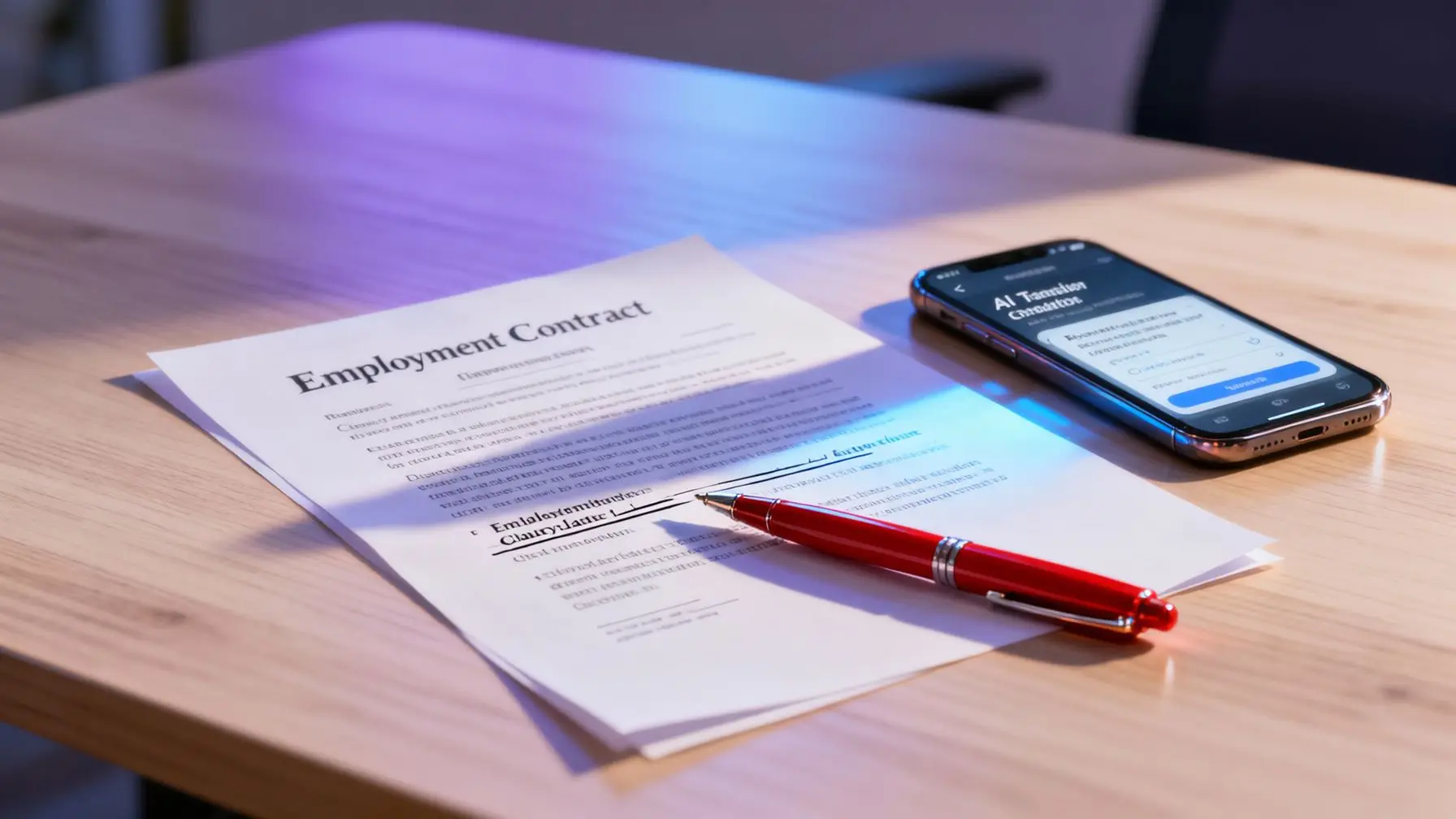
An employment contract written in English, Spanish or German that lands in your inbox, and the reflex is almost always the same: copy-paste into an AI to understand quickly. The result is often readable, sometimes even elegant. The problem is that “readable” and “legally accurate” are not the same thing. An employment contract contains concepts that have no direct equivalent across legal systems, and a general-purpose AI doesn’t always know this.
Why an employment contract isn’t like any other text
Translating an email or blog article—an AI does this very well: the general sense is enough. An employment contract, however, is a text where every word carries weight. A non-compete clause, probationary period, mobility clause or notice period don’t carry the same legal force depending on the country. The vocabulary used isn’t mere window dressing; it produces a legal effect.
A translation AI works through statistical proximity between languages. It seeks the most probable word or phrasing, not the formulation that respects the legal framework of the country of origin or destination. That’s where the costliest errors slip in.
Specific pitfalls in automated contract translation
False legal friends
Some terms translate almost word-for-word but change meaning entirely. “Severance pay” in American English doesn’t have the same regime as a French “indemnité de licenciement.” “At-will employment,” a central concept in American labor law, simply has no equivalent in French law, where dismissal must always be justified. An AI can translate the expression literally without signaling that it describes a legal reality absent from local law.
Clauses specific to a national legal system
Some clauses make sense only in the legal system where they’re written. An Anglo-Saxon non-compete clause can be valid without financial consideration, whereas in French law it’s null if no indemnity is provided. An AI translates the text but won’t tell you that once transposed, the clause could be unenforceable or commit you more than intended.
Wording nuances that change a clause’s scope
In law, a modal verb changes everything. “Shall” imposes a firm obligation, “may” leaves an option. A slightly rushed translation can turn an obligation into mere possibility, or vice versa. In a confidentiality or intellectual property clause, this kind of slip changes the nature of the commitment made.
This type of nuance connects to a broader phenomenon: same prompt, multiple AIs, different answers, and on legal text, these gaps are never trivial.
How to cross-check multiple AIs to verify a sensitive translation
The simplest safeguard, even before consulting a professional, is never to rely on a single translation. Have the same passage translated by two or three different models, then compare:
- Do legal terms remain identical or vary from one model to another?
- Does one AI flag an ambiguity that others ignore?
- Does the general meaning of the clause change depending on the model used?
If all three translations converge, that’s a good sign. If they diverge on a specific point—often a non-compete clause, notice period or mobility clause—that’s precisely the passage a legal professional should review.
This is exactly the kind of verification noov.ai makes possible: access ChatGPT, Claude, Gemini, DeepSeek or Perplexity in a single interface to compare their translations side by side, without opening multiple tabs. On a document as sensitive as an employment contract, this cross-check takes a few minutes and prevents nasty surprises. The same comparison logic is detailed in this article on why using multiple AIs at once, and applies equally to freelance contract review, as explained in Claude vs Gemini for properly reviewing a freelance contract.
What AI will never replace: professional advice
Cross-checking multiple AIs helps identify gray areas, not resolve them. An AI doesn’t have access to the most recent case law, doesn’t know your workplace agreement’s specifics, and can’t evaluate a clause’s real consequences for your situation. For a contract that binds you—permanent position, overseas assignment, internal transfer—AI translation must remain a comprehension step, never final validation.
If a clause seems ambiguous after comparing multiple translations, the right reflex is to submit it to an employment lawyer or legal specialist in the relevant country. This is especially true for non-compete clauses, geographic mobility, contractual termination or any provision related to intellectual property.
In practice: the method to translate a contract safely
- Translate the entire contract with an AI to understand its overall meaning.
- Identify high-stakes clauses: compensation, duration, notice, non-compete, mobility, intellectual property.
- Have these specific passages retranslated by two or three different models and compare wordings.
- List discrepancies and terms with no obvious equivalent in your language.
- Have a legal professional validate sensitive clauses before signing.
This method takes little more time than standard translation, but transforms a quick-understanding tool into a genuine safety net. The same cross-verification principle applies to other sensitive professional documents, as this article on how to summarize a long PDF without losing essentials reminds us.
If you’re still unsure which model to prioritize for this type of task, this guide on how to choose an AI in 2025 provides useful benchmarks to guide your choice based on document type.
Frequently asked questions
Can you trust an AI to translate an employment contract?
An AI helps understand the contract's general meaning, but may mistranslate clauses specific to a national legal system. It's useful for initial review, not for validating a legal commitment.
Which employment contract clauses are riskiest to translate?
Non-compete, geographic mobility, notice period and severance pay clauses are most sensitive, as their legal regime varies significantly across countries.
How do you verify that a legal translation is reliable?
By comparing the translation produced by multiple AIs on key passages. If models diverge on a specific clause, that signals you should have it reviewed by a legal professional.
Can an AI translation replace a lawyer for an international contract?
No. AI lacks access to recent case law or your situation's full context. For a contract that truly binds you, a specialized legal advisor remains essential.